
As we age, everyday tasks can become more challenging. Assistive Technology and Home Modifications (AT-HM) are designed to help older Australians live safely, comfortably, and independently in their own homes for as long as possible.
Under the Support at Home program, eligible participants may access funding for assistive equipment and home modifications that support mobility, personal care, safety, and daily living.
At Mirae Aged Care Cabramatta, we assist clients and families through the entire AT-HM process — from identifying needs to coordinating assessments, applications, purchasing, and installation.
Assistive Technology refers to equipment or devices that help a person perform tasks they may otherwise find difficult due to ageing, illness, disability, or reduced mobility.
These supports are tailored to individual needs and aim to promote independence while reducing the risk of injury or hospitalisation.
Examples include:
The right equipment can make a significant difference — not only for the individual but also for family members and carers.
Home Modifications involve structural changes to make the home safer and easier to navigate.
Common modifications may include:
These changes can help prevent falls, support mobility, and allow people to remain in familiar surroundings with dignity and confidence.
Funding for Assistive Technology and Home Modifications is available to eligible participants under the Support at Home program following appropriate assessment.
Typically, this involves:
Our team can help coordinate these steps and liaise with health professionals and suppliers on your behalf.
Navigating AT-HM applications can feel complex, especially when urgent needs arise. Mirae Aged Care Cabramatta provides comprehensive support throughout the process.
We can assist with:
Our goal is to make the process as smooth and stress-free as possible.
Appropriate equipment and home modifications can:
✔ Reduce falls and injury risks
✔ Improve mobility and daily functioning
✔ Support personal care independence
✔ Reduce strain on family carers
✔ Enable people to remain at home longer
✔ Enhance overall wellbeing and confidence
Investing in the right supports today can prevent more serious health complications in the future.
At Mirae Aged Care Cabramatta, we understand that every individual’s needs, preferences, and living situation are unique. We also provide culturally appropriate support for diverse communities, ensuring clear communication with clients and families.
If you or your loved one may benefit from Assistive Technology or Home Modifications, our team is here to help explore the available options.
If you would like more information about Assistive Technology and Home Modifications under the Support at Home program, please contact Mirae Aged Care Cabramatta.
We are here to support your independence, safety, and comfort — every step of the way.
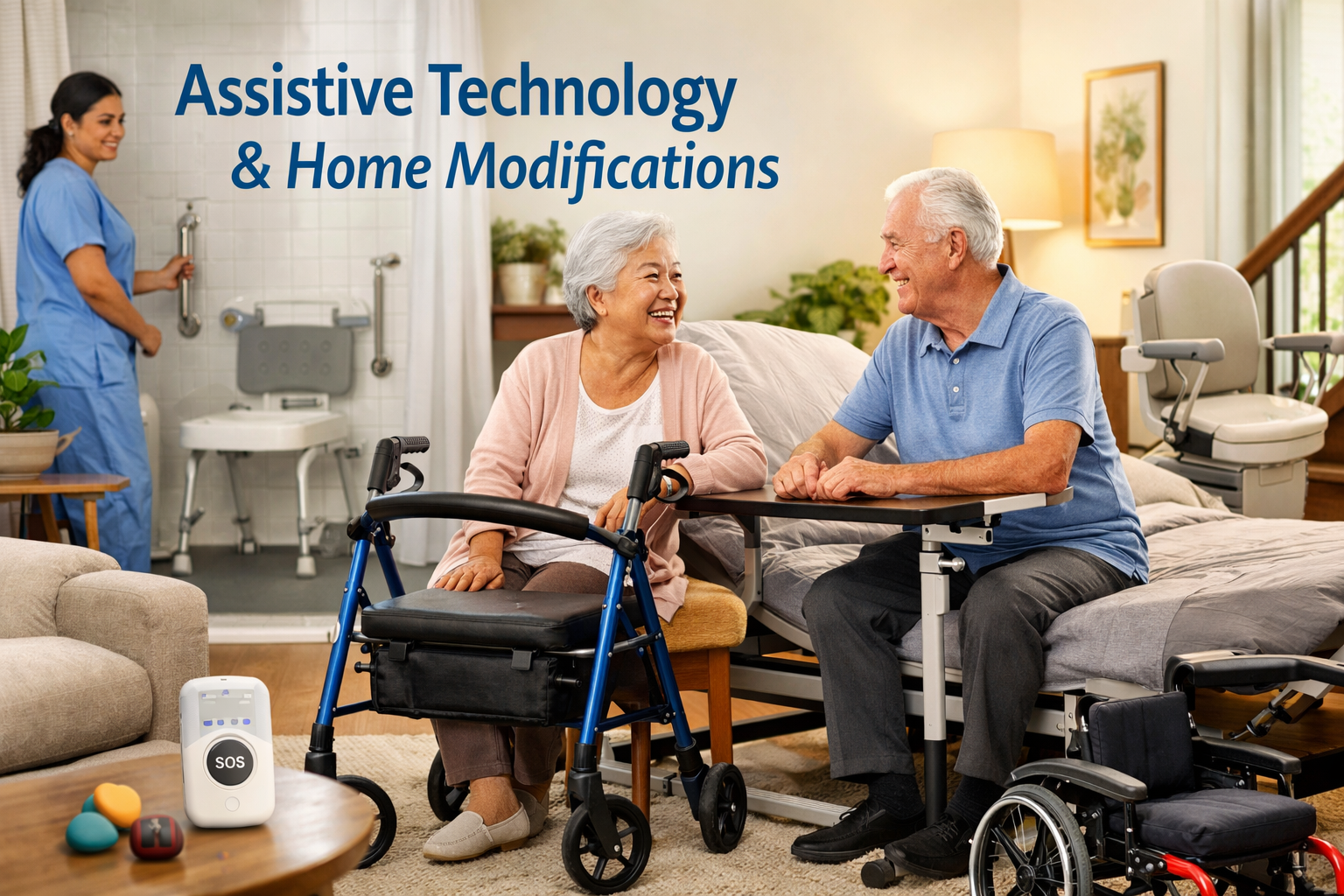
Under government-funded programs such as Support at Home and NDIS, assistive equipment (Assistive Technology) is designed to support individuals with age-related needs or disability, helping them live safely, independently, and with greater comfort at home.
However, not all items are eligible for funding.
Assistive equipment refers to items that are specifically required due to ageing, disability, or functional limitations.
These items must:
Items that may be approved (subject to assessment) include:
? These items are directly linked to ageing or disability needs
General household items are not typically funded, even if they are useful.
This is because they are:
Government funding is designed to support specific care needs, not everyday living expenses.
To be approved, equipment must clearly demonstrate that it:
Most assistive equipment requires:
At Mirae Aged Care Cabramatta, we support you through the entire process by:
Choosing the right assistive equipment can make a significant difference to safety, comfort, and independence.
Our team is here to guide you — ensuring every item is appropriate, approved, and truly beneficial for your needs.
| Classification | Definition | Description | Examples |
|---|---|---|---|
| Low Tier > $500 (Basic, Low-Cost Assistive Technology) | Low-cost, simple equipment that supports everyday safety and independence, with minimal risk. | Suitable for basic needs. Usually does not require a formal clinical assessment. | Non-slip bath mats, jar openers, basic walking aids, simple daily living tools. |
| Medium Tier >$2000 (Standard Assistive Technology) | Moderate-cost equipment that provides additional support for mobility, comfort, and daily activities. | May require advice or recommendation from a health professional depending on the item. | Shower chairs, raised toilet seats, ramps, handrails, over-bed tables. |
| High Tier > $15,000 (Complex Assistive Technology & Home Modifications) | Higher-cost or customised equipment designed for complex care needs and safety. | Requires formal assessment and clinical justification (e.g. Occupational Therapist). | Electric beds, hoists, wheelchairs, major home modifications (bathroom changes, ramps). |
NDIS Assistive Technology (AT) refers to equipment, devices, or systems that help people with disability perform everyday tasks more safely and independently.
These supports are funded under the NDIS when they are considered reasonable and necessary, and directly related to your disability and support needs.
Assistive technology may include:
Not all items are funded as NDIS Assistive Technology. To be approved, equipment must be reasonable and necessary, directly related to your disability, and support your functional needs.
Items that do not meet these criteria are generally not funded.
The following are usually not covered under NDIS Assistive Technology:
NDIS funding is intended to support disability-related needs, not general day-to-day living costs.
To be approved, assistive technology must:
To access funding for NDIS Assistive Technology (AT), the equipment must be included in your NDIS plan and considered reasonable and necessary to support your disability and daily living needs.
1. Check Your NDIS Plan
Your plan must include funding for assistive technology (usually under Capital Supports or Core Supports, depending on the item).
2. Identify Your Needs
Work with your support team to determine what equipment will help improve your safety, independence, or daily functioning.
3. Assessment (If Required)
For more complex equipment, you may need an assessment from a qualified professional, such as an:
They will provide recommendations and a supporting report.
4. Obtain Quotes
You may need one or more quotes for the equipment, especially for higher-cost or customised items.
5. Submit for Approval (If Needed)
Some items require approval from the NDIS before purchase, particularly mid to high-cost assistive technology.
6. Purchase and Claim
Once approved, the equipment can be purchased through your plan funding, either:
Support at Home (SAH) Assistive Technology refers to equipment, devices, or home modifications that help older people live safely, independently, and comfortably in their own homes.
These supports are funded under the Support at Home Assistive Technology and Home Modifications (AT-HM) Scheme, based on your assessed needs.
Assistive Technology under SAH may include:
To access funding for Assistive Technology under the Support at Home program, the equipment must be approved through the AT-HM Scheme and be directly related to your care needs, safety, and independence at home.
1. Assessment of Your Needs
Your care needs are assessed through My Aged Care to determine what supports, including equipment, may be required.
2. Identify Suitable Equipment
Your care provider or care manager will work with you to identify equipment that supports your mobility, safety, or daily living.
3. Clinical Assessment (If Required)
For more complex equipment, an assessment by a qualified professional (such as an Occupational Therapist) is required to provide recommendations.
4. Determine Funding Tier (AT-HM)
Your request will be considered under one of the Assistive Technology funding tiers, based on:
5. Approval Before Purchase
Equipment must be approved before it is purchased. Items bought without approval may not be reimbursed.
6. Purchase and Claim
Once approved, the equipment can be purchased through your provider and claimed under your SAH funding.